Barry was being quiet.
Now, for most children this would not be considered remarkable. But Barry normally treated silence as something deeply suspicious. Usually, silence meant one of three things:
- He was drawing on a wall.
- He was feeding something inappropriate to a pigeon.
- He was attempting science.
His father, Mr Brand, walked between Barry and Marmaduke on the pavement toward school with the wary optimism of a man who had once believed he could assemble IKEA furniture “without the instructions because it’s basically obvious.”
Barry shuffled along slowly.
Marmaduke shuffled too.
Both boys wore tiny backpacks. Barry’s was covered in dinosaurs. Marmaduke’s had a banana printed on it for reasons nobody fully understood, including Marmaduke.
“You two are very quiet this morning,” said Dad carefully.
Barry nodded.
Marmaduke nodded because Barry had nodded.
Dad looked ahead thoughtfully. Perhaps this was maturity. Perhaps they were finally calming down. Perhaps they had reached some important developmental milestone.
This hope lasted nearly twelve seconds.
Barry stopped walking entirely and stared at a drain.
“What do you think lives in there?” he whispered.
Dad sighed softly. There it was.
“Water,” said Dad.
Barry considered this. “A crocodile maybe.”
“In London?”
“They travel.”
Marmaduke looked alarmed. “Do they use buses?”
Before Barry could answer, Alfie marched past them.
If Alfie had been alive in medieval times, villages would have appointed him Official Reminder Not To Touch The Plague Cart.
“Come on,” Alfie said. “We’ll be late.”
“We’re investigating crocodiles,” Barry informed him.
“There are no crocodiles in the drain.”
“You don’t know.”
“I do know. Because crocodiles don’t live in drains.”
Barry leaned toward Marmaduke. “That’s exactly what a crocodile would want him to think.”
Marmaduke gasped.
Dad rubbed his forehead.
School gates appeared ahead, full of parents carrying coffee cups and children carrying germs powerful enough to threaten civilisation itself.
Mrs Baxter from Year Three was listening to a frantic mum explain that her son had “only been sick once after the birthday cake,” as though this was somehow reassuring.
A child nearby sneezed directly into the atmosphere.
Dad delivered the boys to the classroom and escaped to work, comforted only by the fact nobody appeared to be on fire.
Yet.
At first, the morning seemed unusually peaceful.
Barry sat quietly on the carpet during circle time and phonics.
Marmaduke sat pressed against Barry like a nervous emotional-support meerkat.
Miss Patel narrowed her eyes slightly.
Normally Barry contributed constantly during lessons, whether invited or not.
“Can anyone think of a word beginning with B?” she asked.
Usually Barry shouted things like “BURGLAR!” or “BUM!” with tremendous confidence.
Today he merely whispered, “Barry.”
Which, to be fair, was technically correct.
By snack time, Miss Patel noticed Barry’s cheeks were pink.
“Are you alright, Barry?”
Barry shrugged.
Marmaduke immediately raised his hand. “Barry’s not normal today.”
“Thank you, Marmaduke.”
“He only licked one thing.”
Miss Patel paused. “One thing?”
“The glue stick.”
Barry looked offended. “I was checking.”
“Checking what?”
“If it was still glue.”
Miss Patel decided not to continue this conversation.
At ten-thirty, Barry rested his head on the table.
Miss Patel crouched beside him and touched his forehead.
“Oh goodness.”
Barry was roasting.
The school thermometer beeped dramatically.
“Thirty-eight point nine,” said Miss Patel.
Marmaduke looked impressed. “Is that winning?”
“No,” said Miss Patel. “That’s poorly.”
Marmaduke immediately wrapped both arms around Barry.
“There there,” he said solemnly. “If you die, can I have your dinosaur stickers?”
Barry considered it weakly. “Only the shiny ones.”
Miss Patel called the office.
By lunchtime, matters had escalated.
Barry sat wrapped in a blanket looking pale and miserable while sipping water with the tragic dignity of a Victorian orphan.
Meanwhile, Marmaduke had also become suspiciously floppy.
“Do you feel alright?” asked Mrs Green from the office.
Marmaduke blinked slowly. “My knees are tired.”
His temperature was almost as high as Barry’s.
The Calpol appeared.
Children can detect Calpol at distances usually associated with military radar systems. Within moments, several classmates developed mysterious symptoms.
“My throat hurts,” announced Finlay loudly.
“So does my ankle,” added Poppy.
Alfie had visited briefly from the Year Three classroom after hearing Barry was ill. He stood with his arms folded, deeply concerned.
“Did you wash your hands properly?” he asked Barry.
Barry nodded weakly.
“With soap?”
“…mostly.”
Alfie closed his eyes in despair.
Meanwhile, the mums were informed.
Mrs Brand answered the school call while simultaneously replying to work emails and trying to eat a yoghurt.
“The boys both have high temperatures,” said the receptionist.
“Both boys?”
“Yes. Barry and Marmaduke.”
Mrs Brand pinched the bridge of her nose.
Somewhere in the background of the call, Barry could be heard saying faintly:
“If I don’t survive this, tell my Nintendo I loved it.”
By two o’clock both boys looked dreadful.
Marmaduke had become clingier by the minute. He followed Barry around the classroom wrapped in a blanket like a tiny haunted burrito.
“If Barry goes home,” he informed everyone, “I go too because I’m his emotional cousin.”
Nobody knew what that meant.
At half past two, Mrs Brand arrived.
She swept into reception with the determined energy of a woman who had cancelled three meetings already and suspected the universe was mocking her personally.
Barry looked up miserably from the beanbag.
“Mummy.”
“Oh sweetheart.”
Marmaduke looked up too. “Hello, Mrs Brand. I’m also dying.”
“You’re not dying.”
“Can I still have ice cream?”
“We’ll see.”
This was apparently satisfactory.
Mrs Brand collected both boys while Marmaduke’s mum arranged to meet them later at the drop-in centre.
As they walked outside, Barry leaned against her dramatically.
“I’m weak.”
“You’re four.”
“I may not make it.”
“You absolutely will.”
Marmaduke tugged her sleeve. “If Barry dies, do I still have to go to school tomorrow?”
“No one is dying!”
“Okay,” said Marmaduke cheerfully. “Good.”
The drop-in centre smelled faintly of disinfectant and exhausted parenting.
Several miserable children sat in plastic chairs while parents attempted to fill forms one-handed.
A toddler nearby was licking a radiator.
Mrs Brand gently moved Barry’s attention away before he became inspired.
“Sit still please.”
Barry drooped against her shoulder.
Marmaduke drooped against Barry.
Together they resembled two abandoned laundry bundles.
The nurse called them in.
“What seems to be the problem?”
Mrs Brand gave a hollow laugh that suggested the answer could fill several novels.
“High fevers, sore throats, very lethargic.”
The nurse examined Barry first.
“Open wide.”
Barry opened his mouth.
The nurse recoiled slightly.
“Oh dear.”
“What?” whispered Barry.
“Your tonsils are very swollen.”
Marmaduke immediately panicked. “Mine too? Check mine! I don’t want exploding tonsils!”
“Your tonsils won’t explode.”
Marmaduke looked unconvinced.
One examination later, the verdict arrived.
“Tonsillitis,” said the nurse.
“For both of them.”
Mrs Brand sighed. “Wonderful.”
The nurse nodded sympathetically.
“There’s quite a lot going around. Another parent was here last week collecting phenoxymethylpenicillin suspension for their child.”
Mrs Brand blinked.
Of course there was.
Schools, she reflected, were essentially elegant systems for exchanging microbes.
The nurse continued kindly, “We’ll prescribe antibiotics. Plenty of fluids, rest, Calpol, soft foods.”
Barry lifted his head weakly. “Can I have jelly?”
“Yes.”
Marmaduke perked up instantly. “Can I have jelly too?”
“Yes.”
“Can I have Barry’s jelly?”
“No.”
Barry pointed feebly. “See? He’s always after my assets.”
Back home, Alfie was waiting anxiously.
He opened the front door before Mrs Brand even reached it.
“How are they?”
“Tonsillitis,” she said.
Alfie gasped like a tiny Victorian doctor. “I knew it.”
“You knew nothing,” said Barry from her shoulder.
“I knew something was wrong because you were quiet.”
Within minutes, the living room transformed into Sick Child Headquarters.
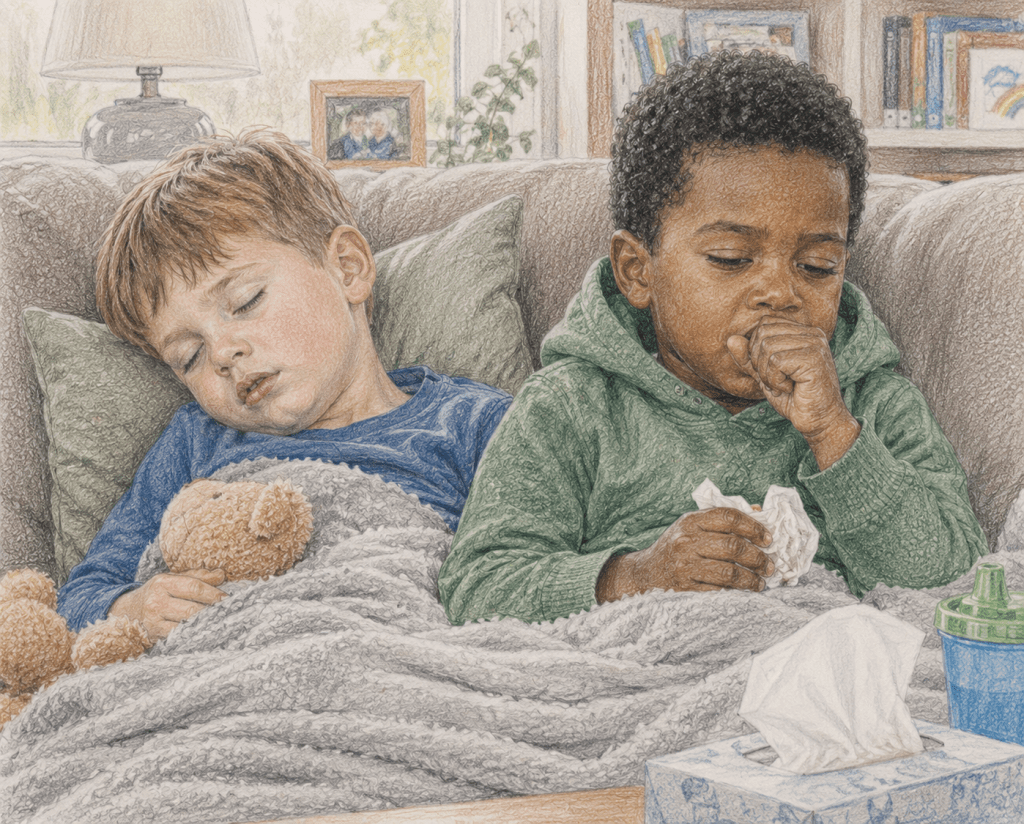
Blankets appeared.
Cartoons appeared.
Medicines appeared.
Dad arrived home carrying groceries and the expression of a man preparing for impact.
“How bad is it?”
“Tonsillitis.”
Dad nodded slowly. “Ah.”
The boys lay on the sofa looking tragic.
“Daddy,” Barry croaked. “If I don’t survive—”
“You’re taking antibiotics, not crossing the Arctic.”
Marmaduke raised a hand. “Can I still stay for tea?”
Marmaduke’s mother arrived moments later and stared at him.
“You are clearly ill.”
“Yes,” said Marmaduke proudly. “I have ton-silly-titis.”
“Wonderful pronunciation,” said Dad.
“Thank you.”
Alfie stood nearby sanitising absolutely everything within reach.
He wiped door handles.
He wiped remotes.
The evening passed in exhausted chaos.
Barry took his medicine with the dramatic suffering of a man swallowing molten lava.
“It’s disgusting.”
“It tastes like strawberries.”
“Bad strawberries.”
Marmaduke took his happily.
“I like medicine.”
Everyone stared at him.
“What?” he said. “It’s pink.”
Later, tucked under blankets, the boys watched cartoons while Alfie read nearby.
Barry suddenly looked thoughtful.
“Marmaduke?”
“Yes?”
“Do you think the crocodile in the drain gave us tonsillitis?”
There was a long pause.
Finally Marmaduke nodded slowly.
“Probably.”
Alfie lowered his book.
“Tonsillitis is caused by germs, not drain crocodiles.”
Barry squinted at him.
“That sounds exactly like crocodile propaganda.”
Dad burst out laughing so hard he nearly dropped his tea.
Even Mum snorted.
Alfie looked deeply offended by the collapse of scientific standards in his own home.
Marmaduke whispered to Barry, “He’s definitely working for the crocodiles.”
Barry nodded solemnly.
Outside, London buses rumbled past in the rainy evening.
Inside, two poorly little boys drifted sleepily beneath blankets while their exhausted parents exchanged the familiar look of adults who knew tomorrow would involve more medicine, more cartoons, and almost certainly someone being sick on soft furnishings.


Leave a Reply