The morning after the Natural History Museum trip, Miss Patel arrived at pre-school feeling strangely optimistic.
This was her first mistake.
Her second mistake had been telling the children yesterday:
“Tomorrow we’ll learn more about fossils!”
To an adult, this sounded educational.
To Barry, it sounded like:
Tomorrow we dig up dinosaur bones.
“Good morning!” Miss Patel said brightly as the children arrived.
Barry marched in carrying a garden trowel.
A full-sized one.
Metal.
Sharp-ish.
Miss Patel blinked.
“…Why do you have that?”
Barry looked surprised she needed to ask.
“For skeletons.”
Behind him, Marmaduke carried a bucket.
“I brought storage.”
Miss Patel closed her eyes briefly.
“No one,” she said carefully, “will be digging up skeletons today.”
Barry’s face fell instantly.
“…Not even tiny ones?”
“No.”
“What about medium spooky?”
“No.”
Marmaduke looked disappointed too.
“My mum said there might be treasure.”
Miss Patel sighed.
“…Your mum was joking.”
Marmaduke thought about this.
“She looked serious.”
Across the room, Alfie was helping set up chairs before school.
“You cannot just dig up skeletons.”
Barry frowned.
“Why not?”
“Because fossils take millions of years.”
Barry paused.
“…That’s too long.”
“Yes.”
Miss Patel clapped her hands.
“Today,” she announced, “we’re making our own skeletons from cardboard.”
There was silence.
The children processed this.
Barry raised his hand slowly.
“So… no real skeletons?”
“No.”
“Not even one?”
“No.”
Marmaduke whispered to Barry, “Maybe she couldn’t find any.”
Barry nodded sadly. “London is busy.”
The morning began with circle time.
Miss Patel held up pictures from yesterday’s museum trip.
Dinosaurs.
Fossils.
Huge skeletons towering over tiny children.
“Who remembers what fossils are?” she asked.
Several hands shot up.
One child said, “Old bones.”
Another said, “Dead things.”
Barry raised his hand confidently.
“Yes, Barry?”
“Very patient skeletons.”
Miss Patel paused.
“…Honestly, that’s not completely wrong.”
She explained carefully.
“Fossils form when plants or animals get buried under mud or sand for a very long time.”
“How long?” Barry asked.
“Millions of years.”
Barry stared at her.
“Million?”
“Yes.”
Barry looked deeply offended.
“That is ridiculous.”
Marmaduke nodded.
“Who waits that long?”
“Nature,” offered Miss Patel. “Over time, the bones slowly turn into rock.”
Barry gasped softly.
“…Rock bones.”
“Yes.”
“That’s amazing.”
Then he frowned.
“…Could my bones become rocks?”
“Not for a very long time.”
Barry considered this.
“…I don’t think I have the patience.”
The children moved to the craft tables.
Cardboard bones had been cut out ready for them to assemble skeletons.
Tiny paper ribs.
Leg bones.
Skulls.
Glue sticks everywhere.
Far too much glitter.
Because apparently all educational crafts eventually involve glitter.
“Right,” Miss Patel said, “we’re building skeletons.”
Barry picked up a cardboard skull.
“…This one looks worried.”
Marmaduke nodded. “Maybe it knows it’s dead.”
At the next table, another child accidentally glued two arm bones to their forehead.
Miss Patel pretended not to notice for a moment because she was emotionally tired.
Barry laid out his skeleton pieces carefully.
This surprised everyone.
Especially Miss Patel.
“I’m doing science,” Barry explained seriously.
Marmaduke copied him immediately.
“I’m also doing science.”
For ten glorious minutes, everything was calm.
Children glued quietly.
Miss Patel relaxed slightly.
She even took a sip of tea.
This was dangerous confidence.
Barry looked at his cardboard skeleton.
Then at the floor.
Then at the garden outside.
A thought had entered his mind.
A very Barry thought.
“Miss Patel?”
“Yes?”
“If fossils happen underground…”
“…Yes?”
“Shouldn’t we bury these?”
Miss Patel froze.
“No.”
“But how will they become real?”
“They are not becoming real.”
Barry frowned.
“That feels negative.”
Marmaduke looked inspired.
“We could bury them in the mud.”
“No,” said Miss Patel immediately.
“Just for a million years,” Barry added helpfully.
“No.”
The children carried on gluing.
Barry attached six extra legs to his skeleton.
“What animal is that?” Miss Patel asked cautiously.
“A mega-dinosaur.”
“It has too many knees.”
“It’s evolving.”
Nearby, Marmaduke had somehow glued his sleeve to the table.
He lifted his arm.
The table moved slightly with him.
“…Miss Patel?”
“Yes, Marmaduke?”
“I think I live here now.”
After the glue-related rescue mission, Miss Patel gathered the children for a fossil activity tray.
Inside were pretend fossils buried in sand.
Safe.
Educational.
Not actual archaeology.
The children used brushes to uncover shells and plastic bones.
Barry looked disappointed immediately.
“These aren’t real.”
“They’re for learning.”
“But where are the ancient skeletons?”
“At museums.”
Barry sighed heavily.
“Museums get everything.”
Marmaduke uncovered a fake fossil shell and gasped dramatically.
“I found treasure!”
“That’s wonderful,” Miss Patel said.
Barry uncovered a plastic dinosaur tooth.
He held it up proudly.
“I found violence.”
Miss Patel moved on quickly.
At snack time, the children sat discussing fossils with enormous confidence despite understanding approximately 12% of the topic.
“My grandad is old enough to be a fossil,” one child announced.
Another child nodded wisely. “Mine makes dinosaur noises.”
Barry bit into an apple thoughtfully.
“I think fossils should happen faster.”
Miss Patel looked tired already. “Why?”
“Because waiting millions of years is bad planning.”
Marmaduke nodded.
“We could speed it up.”
“No,” said Miss Patel immediately.
Barry looked thoughtful again.
The dangerous thoughtful.
“What if we buried things now?”
“No.”
“What if just one thing?”
“No.”
“What if a small thing?”
“No.”
There was silence.
Then Barry brightened.
“What about Kevin?”
Kevin was the class plastic dinosaur.
Miss Patel nearly choked on tea.
“We are not burying Kevin.”
After lunch, the children took their cardboard skeletons outside to dry in the sunshine.
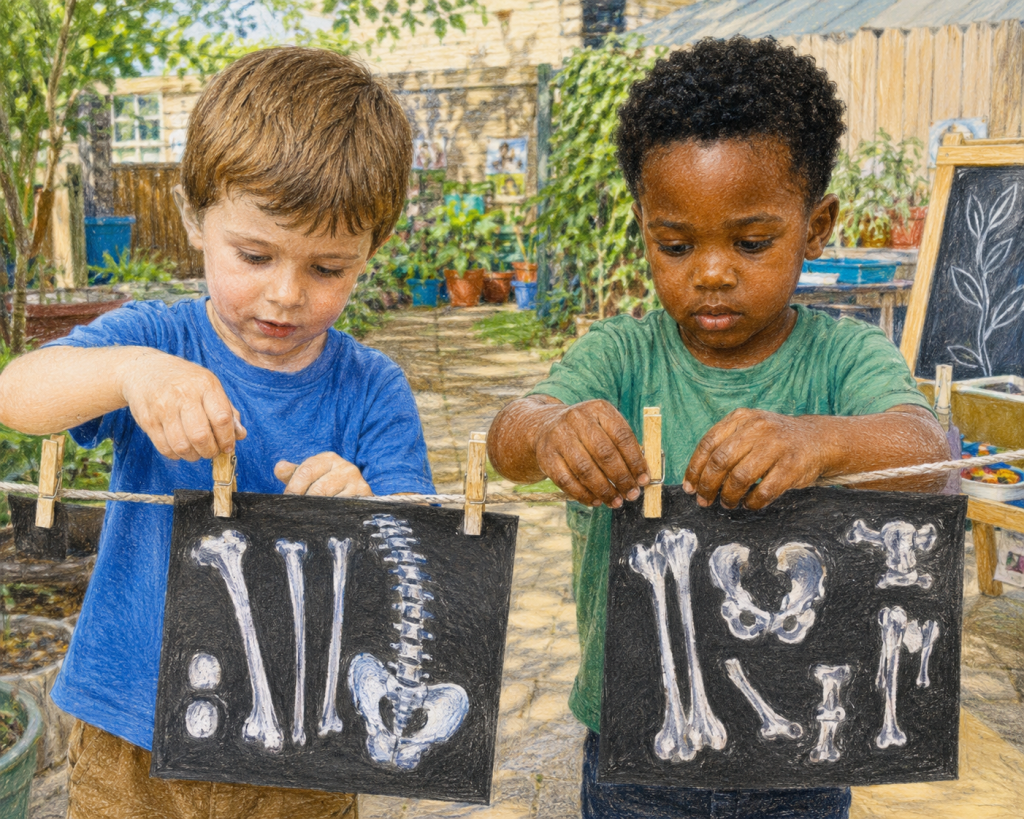
Or what counted as sunshine in London.
Which was mostly brightness with emotional uncertainty.
Barry held his skeleton proudly.
“It needs a name.”
Marmaduke nodded. “Everything important needs a name.”
“What about Boney?”
“That’s excellent.”
Suddenly, a gust of wind swept through the garden.
Skeletons lifted from tables.
Cardboard ribs flew everywhere.
One skull landed in a puddle.
Another stuck briefly to Miss Patel’s leg.
“Catch them!” shouted Barry.
The children ran wildly around the garden chasing flying skeleton parts.
To a stranger looking through the fence, it appeared deeply concerning.
Marmaduke leapt after a cardboard arm bone.
“I GOT THE FEMUR!”
“That’s not the femur,” Alfie said, arriving to collect Barry later.
“It’s definitely a femur.”
“It’s an arm.”
Barry finally rescued Boney from under a bush.
One leg was missing.
Several ribs had folded.
Its skull now faced slightly sideways.
“It survived,” Barry announced proudly.
“It looks injured,” Alfie corrected.
Miss Patel sat down slowly on a tiny plastic chair.
The kind designed for preschoolers, not exhausted adults questioning career choices.
At home later, Mum asked, “How was fossil day?”
Barry dumped Boney proudly on the kitchen table.
“We made skeletons.”
Dad looked up from his laptop.
“…Why does that one have six legs?”
“Evolution,” Barry replied immediately.
Marmaduke, still staying for tea, nodded wisely.
“Science happened.”
Alfie inspected Boney carefully.
“It’s anatomically impossible.”
Barry grinned.
“That means creative.”
Mum smiled.
“Did you learn about fossils?”
“Yes,” Barry said.
“They take trillions of years.”
“And that,” Dad said, “is why we don’t have fossils in the garden.”
Barry looked disappointed again.
“…Yet.”
That evening, Barry tucked Boney beside his bed.
One cardboard arm immediately fell off.
Barry sighed.
“Millions of years is a long time.”
And as the house finally settled into silence, one thing was absolutely certain:
Barry loved dinosaurs.
Marmaduke loved adventure.
Miss Patel deserved a very large cup of tea.
And no one—
Absolutely no one—
Should ever give preschool children access to archaeology equipment.


Leave a Reply