World Bee Day began with panic.
Not normal panic.
Specific panic.
The sort of panic that only happens when a four-year-old wakes up absolutely convinced he has swallowed a bee in his sleep.
“I can feel buzzing,” Barry announced dramatically at breakfast.
Mum looked up from her laptop. “That’s your stomach.”
“It could be bees.”
“It’s toast,” Alfie said calmly.
Barry frowned. “You don’t know.”
“I do.”
Marmaduke arrived five minutes later wearing a yellow-and-black striped T-shirt.
“I am dressed as a bee,” he announced proudly.
“You look like a tiny referee,” Dad said.
Marmaduke looked delighted. “Thank you.”
Today was World Bee Day at pre-school, which Miss Patel had described in the newsletter as:
A wonderful opportunity for children to learn about pollinators and nature.
What she meant was:
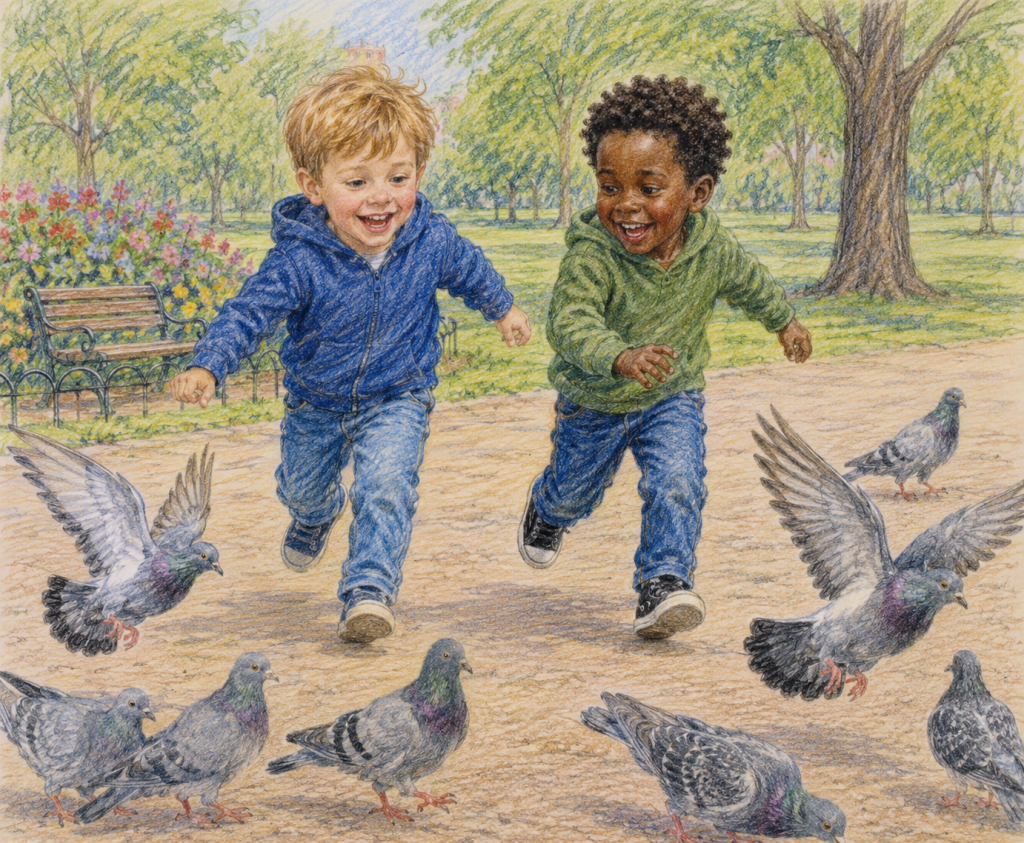
Twenty small children running around shouting “BEE!” at pigeons.
At nursery, Miss Patel stood holding several laminated bee identification charts.
The children sat around her excitedly.
Mostly.
One child was licking a glue stick.
Another was wearing their shoes on the wrong feet.
Education is beautiful in many forms.
“Today,” Miss Patel said brightly, “we are going to learn about bees!”
Barry gasped. “Real bees?”
“Yes.”
“Alive bees?”
“…Ideally.”
Miss Patel held up a chart.
“These are different types of bees. Bumblebees, honeybees, mining bees—”
Barry raised his hand.
“Yes, Barry?”
“Which one is the dangerous bee?”
Miss Patel paused. “Most bees are not dangerous.”
“What about angry bees?”
“Well… don’t annoy them.”
Barry nodded seriously. “Good advice.”
Marmaduke examined the chart carefully.
“They all look fluffy.”
“They are fluffy,” Miss Patel agreed.
“I like fluffy danger,” Marmaduke said.
Miss Patel continued. “Scientists identify bees by looking carefully at their colour, size and markings.”
Barry squinted at the chart.
“How do you measure a bee?”
“With care,” Miss Patel replied.
This was, unfortunately, not enough information.
Soon the children lined up for the walk to the park.
Each child carried:
- A bee chart
- A pencil
- A ruler
This already felt optimistic.
Barry marched beside Marmaduke.
“We are basically bee detectives,” Barry whispered.
Marmaduke nodded. “Nature police.”
The local park was full of flowers.
Bright flowers.
Buzzing flowers.
Very busy flowers.
The bees were having an excellent day.
Miss Patel less so.
“Remember,” she called, “we look gently!”
The children nodded.
Then immediately scattered in twelve different directions.
“BEE!” Barry shouted.
Miss Patel turned sharply.
It was a pigeon.
Again.
Eventually, they found a real bee.
A fat bumblebee lazily floating around a patch of lavender.
The children gathered carefully around.
“Well done,” Miss Patel said. “Now, can anyone identify it?”
Barry looked at the chart.
Looked at the bee.
Looked back at the chart.
“It’s fluffy.”
“Yes.”
“And stripy.”
“Yes.”
“And buzzy.”
“…Also yes.”
Marmaduke pointed proudly. “BUMBLEBEE.”
Miss Patel smiled. “Correct!”
The children clapped.
The bee ignored them completely.
Then Barry remembered something important.
“We need to measure it.”
Miss Patel froze slightly.
“…Carefully.”
Barry held out his ruler.
The bee flew away.
Barry followed it.
The bee changed direction.
Barry changed direction.
Soon Barry was jogging around a flower bed waving a ruler through the air like an extremely tiny traffic officer.
“Stay calm!” Miss Patel called.
“I AM CALM!” Barry shouted while chasing an insect at full speed.
Marmaduke joined in.
“It stopped!”
“No it didn’t!”
“It looked slower!”
“That was a leaf!”
The bee landed briefly on a daisy.
Barry crept closer.
Very slowly.
Very carefully.
Tongue sticking out in concentration.
He placed the ruler beside the flower.
The bee flew away again.
Barry sighed heavily.
“This is impossible.”
“That,” said Miss Patel gently, “is why scientists usually don’t measure flying bees with school rulers.”
Marmaduke looked impressed. “Scientists are smart.”
“Yes,” Miss Patel replied. “Very.”
Another child pointed suddenly.
“I found one!”
Everyone rushed over.
Too fast.
Far too fast.
The bee left immediately.
“Oh dear,” said Miss Patel.
Barry looked offended. “It escaped us.”
“It flew away because twenty children stampeded towards it,” Miss Patel corrected.
Near the pond, Alfie’s class happened to be walking through the park from school.
Alfie spotted them instantly.
Mostly because Barry was lying on the grass trying to “think like a bee.”
Alfie walked over carefully.
“What are you doing?”
Barry looked up. “Research.”
Marmaduke nodded. “Bee psychology.”
Alfie blinked slowly. “…Right.”
“We’re measuring bees,” Barry explained.
“With rulers,” Marmaduke added proudly.
Alfie stared at the rulers.
Then at the flying insects.
Then back at Miss Patel, who looked like she had aged slightly.
“…That seems inefficient.”
“It’s very hard,” Barry admitted.
A bee landed nearby.
Everyone froze.
Barry slowly lowered the ruler.
Marmaduke leaned in.
Alfie crouched carefully.
For one glorious moment—
Peace.
Science.
Teamwork.
Then Barry sneezed.
The bee vanished.
Marmaduke fell backwards into a bush.
Alfie sighed the sigh of a child who had already accepted disappointment as part of life.
Miss Patel clapped her hands.
“Alright everyone, snack time!”
The children cheered.
Because learning is wonderful, but snacks are immediate.
They sat on blankets eating fruit.
Barry looked thoughtful.
“I think bees have difficult jobs.”
Miss Patel smiled. “They do.”
“They work all day.”
“Yes.”
“And everyone bothers them.”
“…Also yes.”
Marmaduke nodded. “And flowers are very far apart.”
Miss Patel opened a juice carton with the energy of someone nearing the end of a long expedition.
“Bees are very important for nature,” she explained.
“They help plants grow.”
Barry blinked. “So bees help make food?”
“Yes.”
Barry looked horrified. “What if they all go on holiday?”
Miss Patel paused.
“…That would be a problem.”
Barry thought deeply about this.
“We should be nicer to bees.”
“I agree,” said Miss Patel.
“We could build tiny bee houses.”
“People do that.”
“We could give them snacks.”
“The flowers are the snacks.”
Barry nodded slowly. “Nature is organised.”
As they packed up to leave, Marmaduke suddenly shouted:
“LOOK!”
A huge bumblebee hovered near the path.
Fat.
Golden.
Magnificent.
The sort of bee that looked too fluffy to function properly.
The children stared in awe.
Barry whispered, “That’s the king bee.”
“There’s no such thing,” Alfie said.
“There should be.”
The bee drifted lazily past them all before disappearing into the flowers.
The children watched quietly.
Even Barry.
For almost seven whole seconds.
Back at home, Mum asked, “How was World Bee Day?”
Barry sat down dramatically.
“Exhausting.”
Dad looked up from making tea.
“What happened?”
“We chased bees.”
“You chased bees?”
“For science,” Marmaduke clarified.
Alfie walked in behind them.
“They attempted to measure flying insects with rulers.”
Dad blinked.
“…Why?”
“Education,” Alfie replied dryly.
Mum smiled. “Did you learn anything?”
Barry nodded seriously.
“Yes.”
“What?”
“Bees are important.”
“Good.”
“And difficult to measure.”
“Also good.”
“And fluffy.”
Marmaduke added, “Very fluffy.”
Dad handed out biscuits.
Barry held his thoughtfully.
“I think bees deserve more respect.”
Dad nodded. “That’s fair.”
Barry took a bite.
“And less chasing.”
“Definitely less chasing,” said Miss Patel’s tired voice somewhere in the distance of everyone’s imagination.
That evening, Barry stood in the garden looking at a bee drifting between flowers.
He waved politely.
“Sorry about the ruler,” he said.
The bee ignored him.
Which was honestly fair enough.
And as World Bee Day came to an end, one thing was clear:
Bees were clever.
Nature was amazing.
And trying to measure a flying insect with nursery equipment
Was exactly the sort of idea
That sounds excellent
Right up until you actually try it.


Leave a Reply