Miss Patel regretted her outdoor learning idea at approximately 9:14am.
Unfortunately, by then, it was too late.
The children had arrived.
The picnic blankets were out.
The garden gates were open.
And Barry had already announced to everyone that he was “basically wild now.”
The idea had sounded lovely in the staff meeting.
Outdoor learning.
Fresh air.
Nature.
Connection with the environment.
What the staff meeting had not fully considered was:
British weather.
“Yes,” Miss Patel had said confidently the day before, “we’ll continue our World Bee Day activities by spending the whole day outside.”
Today, standing in the nursery garden while a freezing breeze blew directly through her cardigan, she realised the weather app had lied to her personally.
Still, she smiled bravely.
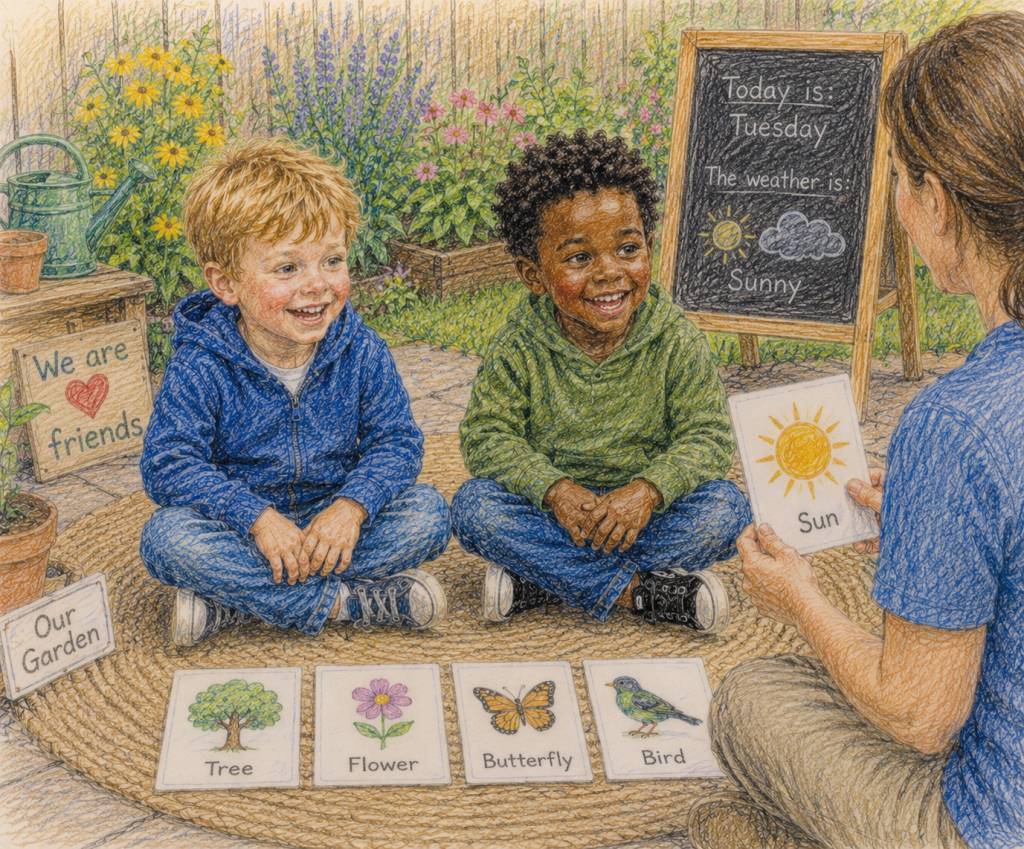
“Good morning, everyone!”
The children bundled into the garden wearing varying levels of preparation.
Some had coats.
Some had sunhats.
One child was inexplicably wearing wellington boots and shorts.
Barry had arrived dressed like someone going on safari.
“I brought my explorer backpack,” Barry announced proudly.
Inside were:
- One squashed banana
- A toy dinosaur
- Three sticks
- Half a cereal bar
- A sock
Marmaduke looked impressed. “You are ready for nature.”
Miss Patel clapped her hands.
“Today, we are learning outside!”
The children cheered.
Mostly because they thought this meant no rules.
“It does not mean no rules,” Miss Patel added immediately, correctly reading their faces.
Barry lowered his hand slowly. “…Not even a few less rules?”
“No.”
They began with circle time on the grass.
The children sat in a wobbly circle on blankets.
The wind blew continuously.
One blanket immediately tried to escape into a bush.
“Today,” Miss Patel began, holding down worksheets with one foot, “we are going to think about nature.”
Barry looked around dramatically.
“I already am.”
Marmaduke pointed at a worm.
“Nature!”
“Yes,” Miss Patel said patiently. “That’s a worm.”
The worm wriggled away, perhaps sensing the attention.
“Who remembers what we learned yesterday about bees?”
Barry’s hand shot up.
“They are fluffy.”
“Yes…”
“And hard to measure.”
“…Also yes.”
“And they hate rulers.”
Miss Patel sighed quietly. “Possibly.”
The breeze grew stronger.
Several children shivered.
Miss Patel smiled through gritted teeth.
“It’s… fresh.”
Barry looked at her. “You’re cold.”
“I’m fine.”
“You look like my dad when he forgets his coat.”
Marmaduke hugged himself dramatically.
“My knees are freezing.”
“Your knees?” Barry asked.
“Yes. Especially the left one.”
Next came story time.
Miss Patel held up a book about butterflies.
The children gathered closer.
Mostly because it was warmer near another human being.
“The Very Busy Butterfly,” Miss Patel read.
Barry interrupted immediately.
“Butterflies don’t look busy.”
“They are busy,” Miss Patel said.
“They mostly flap.”
“That is what butterflies do.”
Marmaduke squinted at the illustrations.
“That butterfly has a better life than me.”
Miss Patel blinked. “…In what way?”
“It gets flowers all day.”
Barry nodded. “That is quite good.”
As the story continued, a butterfly from the nursery hatchery fluttered gently inside its enclosure nearby.
The children gasped.
Even Alfie, who had come through the garden gate briefly with his class during morning break from school, stopped to look.
“Are those the butterflies for tomorrow?” Alfie asked.
Miss Patel smiled. “Yes. We’re releasing them tomorrow.”
Barry stared closely at one.
“…It looks delicate.”
“That’s because it is,” Alfie said.
Barry nodded thoughtfully.
Then immediately tapped the enclosure.
“Barry,” said both Miss Patel and Alfie at exactly the same time.
Barry withdrew his hand slowly.
“…I was encouraging it.”
By mid-morning, the outdoor maths lesson began.
Miss Patel placed giant number cards around the garden.
“Today we’re learning numbers five to ten.”
Barry groaned. “I already know five.”
“Yes,” said Miss Patel, “but now we’ll learn the others.”
“Who can find number six?” she asked.
Marmaduke pointed confidently at a flowerpot.
“That’s a daffodil,” Alfie said flatly.
Barry found number eight.
Then accidentally sat on it.
“It’s under me,” he announced helpfully.
The wind picked up again.
One number card flew into the mud.
Another landed in the water tray.
Miss Patel chased a laminated number seven across the garden while trying to maintain educational dignity.
It was not entirely successful.
Lunch was outdoors too.
This sounded charming.
In reality, it involved twenty children trying to stop crisps blowing into neighbouring boroughs.
Barry sat cross-legged eating his sandwich.
“This is like camping.”
“No it isn’t,” Alfie replied.
“We’re outside.”
“Yes.”
“We’re eating outside.”
“Yes.”
“That’s camping.”
Marmaduke opened his lunchbox.
The wind immediately stole a napkin.
He watched it drift away sadly.
“…Goodbye.”
Miss Patel sipped cold tea from a travel mug and wondered briefly if indoor teaching had actually been underrated all these years.
Then came The Incident.
Every outdoor school day has one.
This one belonged to Barry.
Barry wandered towards the hedge.
Thoughtfully.
Quietly.
Too quietly.
Marmaduke followed him.
Because of course he did.
“Barry,” Marmaduke whispered, “what are you doing?”
Barry looked around.
“Well,” he said, “everything else is outside today.”
“Yes…”
“So maybe the toilet is outside too.”
Marmaduke blinked.
This logic made terrible sense.
Nearby, Miss Patel was helping another child untangle yoghurt from their jumper when she noticed Barry standing suspiciously near the flower bed.
Very suspiciously.
The kind of suspiciously that teachers recognise instantly.
“Barry?” she called.
Barry froze.
Slowly turned around.
“…Yes?”
“What are you doing?”
There was a pause.
A long pause.
“Science?”
Miss Patel narrowed her eyes.
Then she noticed Marmaduke looking horrified.
Never a good sign.
“Barry,” she said carefully, “why are you standing behind the compost bin?”
Barry looked genuinely confused.
“I thought the toilet was outside now.”
There was silence.
Even the wind seemed embarrassed.
Miss Patel closed her eyes briefly.
“The toilet,” she said slowly, “is still inside.”
“Oh.”
Barry considered this.
“That makes more sense.”
Marmaduke nodded seriously. “I did think the flowers might complain.”
Miss Patel marched them both inside immediately.
The rest of the children watched with deep interest.
One child whispered, “Barry nearly weed in nature.”
Another whispered back, “Nature probably didn’t want that.”
When they returned, Alfie happened to be walking past the garden again with his class.
He took one look at Barry’s face.
“What happened now?”
Barry sighed.
“I misunderstood outdoor learning.”
Alfie nodded. “Of course you did.”
By the afternoon, everyone was tired.
The children.
The staff.
Even the butterflies looked emotionally drained.
Miss Patel gathered everyone together for one final activity.
“Before we go home,” she said, wrapped tightly in her cardigan, “let’s talk about what we enjoyed today.”
Barry raised his hand.
“Yes, Barry?”
“I liked the butterflies.”
“Good.”
“And lunch outside.”
“Lovely.”
“And not using the flower bed as a toilet.”
Miss Patel blinked slowly. “…Excellent.”
Marmaduke raised his hand too.
“I learned my knees can get cold.”
“That’s… useful.”
Another child said they liked the bees.
Another liked the story.
One child simply said, “I miss indoors.”
Several adults silently agreed.
At home later, Mum asked, “How was outdoor learning?”
Barry grinned.
“Amazing.”
Dad looked up from his laptop. “What did you do?”
“We learned outside.”
“We ate outside.”
“We nearly weed outside,” Marmaduke added helpfully.
Mum paused mid-sip of tea.
“…You nearly what?”
Barry pointed quickly.
“Not me.”
“It was definitely nearly you,” said Alfie.
Dad leaned back slowly.
“…Miss Patel deserves a medal.”
“Yes,” Mum agreed immediately.
Barry sat happily on the sofa.
“I think nature is good.”
Marmaduke nodded. “Very educational.”
Alfie added, “And apparently dangerous to flower beds.”
And as the day finally came to an end, one thing was absolutely certain:
Outdoor learning sounded magical in theory.
But in practice—
It mostly involved cold teachers, confused children, runaway worksheets,
and Barry nearly fertilising the daisies.
 Alfie, Barry and Marmaduke Stories
Leave a comment